اولین لنز گرانشی ایجاد شده توسط کوازار ، کشف شد
پدیده ی لنز گرانشی که یکی از دستاورد های نظریه نسبیت عام انیشتین محسوب می شود بارها و بارها با خلق تصاویر زیبای حلقه ها و کمان ها مشاهده شده.
در این پدیده ی زیبا، نور منتشر شده از جسم پر جرم بسیار دور - مثلا کهکشان - زمانی که از نزدیکی جسم پر جرمی دیگر که در مسیر دید ناظر قرار دارد ، عبور می کند ، خم شده و تصاویری زیبا ایجاد می کند.
این بار برای اولین بار یک کوازار باعث خلق یکی از این تصاویر شده است !
در ادامه خبر مربوط به این موضوع را برای علاقه مندان قرار داده ام . . .
Gravitation lensing – a phenomenon that falls out of Einstein's theory of general relativity – has been observed numerous times, making for some fantastic images of rings, arcs and crosses composed of massive galaxies light years away. As the light from a background object is bent by gravity around a foreground object, multiple, magnified images of the background object are produced from our vantage point.
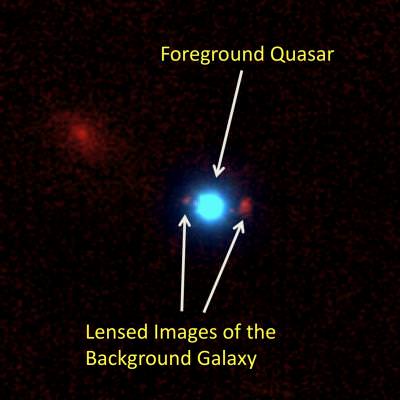
The quasi-stellar object SDSS J0013+1523 has been shown to warp the light of a background galaxy around it, producing a magnified double-image from our perspective on Earth. Image Credit: Courbin, Meylan, Djorgovski, et al., EPFL/Caltech/WMKO
For the first time, a quasar (quasi-stellar object) has been shown to gravitationally lens a galaxy behind it. About a hundred instances of gravitational lenses that consist of a foreground galaxy and a background quasar have been found, but this is the very first time where the opposite is the case; that is, a quasar bending the light from a background galaxy around it to create a multiple image of that galaxy.
Quasars are thought to be the result of a supermassive black hole at the center of a galaxy attempting to swallow up all of the matter that surrounds it. As the matter bunches up when it gets closer to the black hole, it heats up due to friction and begins to emit light across the electromagnetic spectrum. The light from a quasar can outshine an entire galaxy of stars, making it difficult to separate the light from a background galaxy from the overwhelming glare of the quasar itself.
To make this initial detection (there are surely many to follow), astronomers from the EPFL's Laboratory of Astrophysics in cooperation with Caltech used data from the Sloan Digital Sky Survey (SDSS). They analyzed 22,298 quasars from the SDSS Data Release 7 catalog, and looked for images that had a strongly redshifted emission spectra. According to the paper announcing the results, "In these spectra, we look for emission lines redshifted beyond the redshift of the [quasar]."
In other words, a quasar that is lensing a galaxy in the background will exhibit a higher redshift than one that is not lensing a background galaxy, since the light from the galaxy and the quasar are combined in the SDSS data. So, quasars that had an expected redshift were thrown out, and a statistical analysis of quasars with emission lines that might mimic a gravitational lens eliminated many more of the objects. This left about 14 objects of the 22,298 analyzed as potential candidates. Of these 14, the team selected one to perform follow-up observations on, named SDSS J0013+1523.
SDSS J0013+1523 lies about 1.6 billion light years away, and is lensing a galaxy that is about 7.5 billion light years away from Earth. Using the Keck II telescope, they were able to confirm that SDSS J0013+1523 was indeed lensing the light from a galaxy located behind it. Hubble images of the discovery are in the works.
Here's a video produced by the EPFL describing the results.
What is significant about this discovery – besides the novel aspect of a quasar acting as a lens – is that it will allow researchers to better refine their understanding of quasars. When light is bent around an object, it bends because of gravity, and gravity is a result of mass. So, something that is very massive will act as a stronger lens than something that is tiny, and the mass of the object doing all of the lensing work – in this case, the foreground quasar – can be determined.
Their results were published in a letter to Astronomy & Astrophysics on July 16th. The original paper is available for your perusal here.
Source: Eurekalert here and here, Arxiv paper here
منبع : universe today
 سلام و درود فراوان بر بازدید کنندگان محترم .